Showing posts with label anecdote. Show all posts

Tuesday, March 20, 2012

On Being a Critic

Probably not the best singer out there
Everyone has a right to be a critic. We can each form our own judgement - about anything really, from songs to films, food and politics. We are often asked to fill in evaluation or feedback forms for certain events we've attended, or for our colleagues and supervisors in the office or university. I'm not sure about you, but I get stuck every time I arrive at the 'Suggestions for improvement' section. I usually just write 'None'. So what makes a good critic? 

Can Simon Cowell sing? Can any of the Rotten Tomatoes critics make a successful film? Can the opinionated political columnists run the country? Of course not! 

I think it must have occurred to us that the best critics are usually under-performers in the field that they themselves judge. But why?

To be a good critic, one must be able to easily highlight the weaknesses of others specific to their particular field of interest. However, in order to see what's wrong with others, we must first be blind to our own imperfections. That's because the urge to criticise is usually triggered by the feeling of disgust. And like I said before, we feel disgusted only when we see the ignored part of our character and personality in other people. Let me give one example.

During medical ward rounds, as students, we are often encouraged to present the case of patients we have clerked to the consultant. Although it seems like a straightforward process of regurgitating the medical history elicited from the patient, case presentation during ward rounds can be tricky. First, you must make sure you got enough information from the patient, or your history would be incomplete. Then, when you present the case, you must trigger some interest from your consultant, not making it too long that it would bore your audience, or too brief that you lose all the important bits out.

When I listen to my colleagues presenting a case, I find it quite easy to make a mental list of criticisms and how they could have done it better. Of course, I never share these thoughts with them, as not to be impolite. I'd like to think that I can do better than my colleagues, but the truth is I can't. The fact that it's too easy for me to criticise my colleagues' case presentation only highlights my own weaknesses in this particular area. 

Another way to see this is to consider who makes the worst judge - one who praises more easily than criticising. If one is allowed to speak freely and not inhibited by trying to be polite, and yet has nothing bad to say to most people about his field of expertise, that is not because he is simply being too nice. It must be that he does not feel disgusted by the poor performance of others, as he had long realized his own imperfections in that area. 

Indeed the first step to great success is to admit our worst weaknesses.

Sunday, February 12, 2012

Two Birds on a Tree

From the Upanishad:
Two birds, inseparable friends, cling to the same tree. One of them eats the sweet fruit, the other looks on without eating.  
On this same tree a person, sunk and grieving in slavery, is deluded, but upon observing the Lord happy and great, becomes free of sorrow.

Look at our friends on facebook. Many of them are having such a great time with their life - indulging good food, travelling the world, graduating from university, earning a salary, getting married, having kids, etc. Meanwhile, we reflect on what we have achieved in our life so far. 

If only we worked harder, we would have been admitted to a better college, like some of our friends. If only that happens, we could be offered a better job. And if only we get a higher pay, we could afford a bigger house, a faster car and support a bigger family. Ah, what a happy life that would be!

And so we thought.

....

How can the other bird looks on without eating the sweet fruit

The important point here, I think, is the bird's conscious decision to refrain from eating the sweet fruit -  although it wasn't forced to do so. Seeing its friend enjoying the fruit may be enough to keep the bird content. Maybe it has already eaten before clinging on to that tree. 

Wednesday, February 8, 2012

Self-Restraint

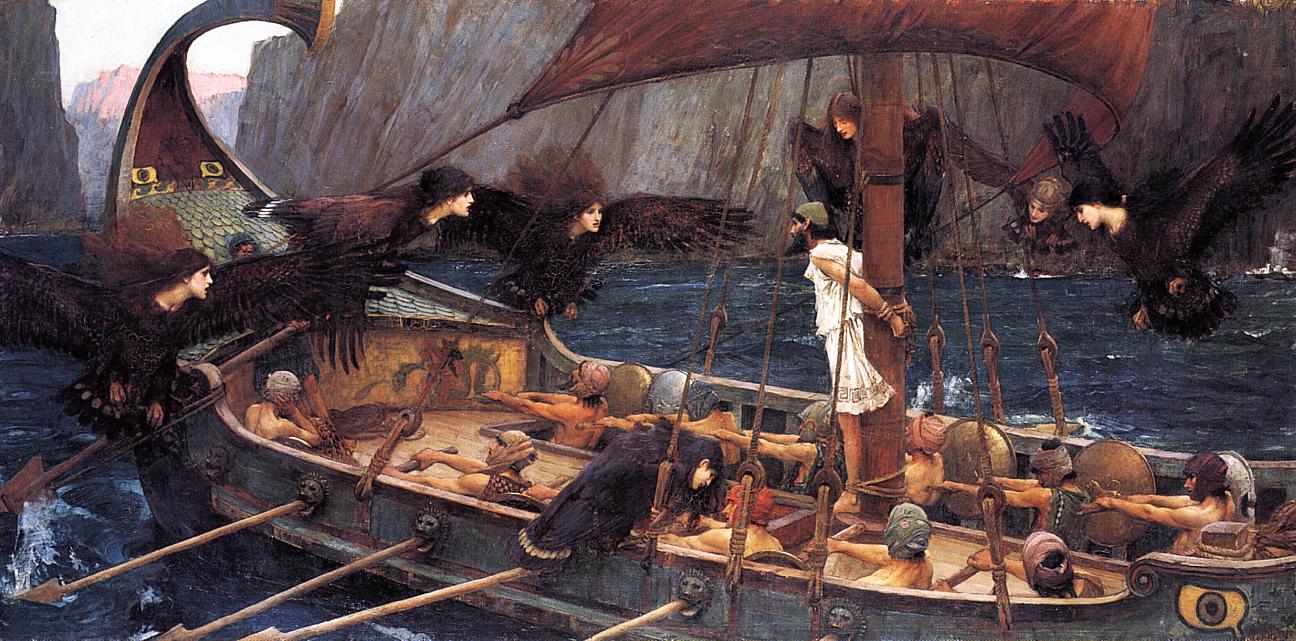
Have you heard about the Sirens? These are mythical oceanic creatures that lure sailors who can hear their enchanting voices - to approach them - only to the sailors own demise!

A wise king, Odysseus, got to hear the sirens and escaped unharmed.

Odysseus and the Sirens (1891) by John William Waterhouse.
He had all his sailors plug their ears with beeswax and tie him to the mast. He ordered his men to leave him tied tightly to the mast, no matter how much he would beg. When he heard their beautiful song, he ordered the sailors to untie him but they bound him tighter. When they had passed out of earshot, Odysseus demonstrated with his frowns to be released (Wikipedia)

Maybe we can learn something from Odysseus. Yesterday I discussed our hyperlink addiction (aka Internet ADHD) and the potential brain mechanism behind this phenomenon. Maybe there's a way to manage our behaviour of clicking one link over another aimlessly.

Let's have some self-restraint. Keep a minimum number of opened tabs (pages). Keep your hands away from the mouse once a new page is loaded (so we can't immediately click on a link to open yet another page). Turn off the computer when it's time to do so, even when there's some work left to do. And most of all, avoid (or at least minimize) trivial internet uses such as 24hr social networking, 9gags, stumbleupon, etc.

Tuesday, January 31, 2012

Who's Going to Read It?

An innocent anthropologist reached a small West African town, when he found a notice of a campaign against illiteracy that read:
The illiterate adult, incapable and lacking information, has always constituted an obstacle to the setting of any initiative tending towards the general upliftment of a country.


The anthropologist mused,

"It was not clear how illiterates were supposed to read the placard."


excerpts from The Innocent Anthropologist by Nigel Barley

Wednesday, January 25, 2012

Our Precious Yet Fragile Memory

I was sitting in a neurology clinic recently when I saw a lady in her late-70s with a chief complain of memory problems. In fact, the complain came from her concerned husband who was also present to meet the consultant neurologist. The patient, a lady with some memory loss was quite unaware of her situation. According to her husband, she also struggled to recognize him at times! She had to be corrected by her husband many times throughout the consultation, only to her embarrassment. 

How much do we value our memory? Isn't it the one thing that glues together all our experience into a meaningful narrative, and gives meaning to our private lives?

----

We forget a lot of things all the time - except the savants among us, of course. And yet there are things that get stored in our memory - intentionally or otherwise. Things that we want to remember, especially our achievements, memories of our loved ones, relevant knowledge to pass exams, etc are not the only ones that define our being. In fact, even memories that we try hard to forget like embarrassing moments and hateful things also make us who we are.

So what is it like to lose our memory? To the person who is losing all her memory, it will cause some confusion and distress, quite obviously. "Where am I? Who are you? ...Who am I?"


But there will be even more distress for the carer, and loved ones. On top of the trouble of looking after people with dementia, the fact that someone who once knew you really well could no longer recognize you would make you even more upset. 

Without realizing it, the sadness and pity that we feel when we find out that someone we care about is suffering from dementia - or any memory problems - actually comes from of our own insecurity facing the new reality that the other person no longer remembers us. We'd then ask ourselves, "Who else cares about me?"

Monday, November 28, 2011

Sunday, August 28, 2011

Challenge Completed

Voltaire (1694-1778) - French writer and philosopher
 Earlier this year, I challenged myself to read 50 books throughout 2011. I have always set to follow the path of those who came before me - to study their wisdom, heed their advice, and learn from their mistakes - by reading what they have put down in paper. Of course, not all sages wrote books. Some of those that I read were published posthumously (after the author has passed away); others, were not received well when they were first published; while others were popular right from the beginning. 

Last night, in one of my journeys in the London Underground, I completed this challenge - as I read the closing paragraph of a satire entitled Candide (1759) by Voltaire. 
"All that is very well," answered Candide, "but let us cultivate our garden."
It is story of a young man named Candide, who was taught that all in life is good - only humans make it bad. He truly admired his teacher and accepted his philosophy wholeheartedly - but then something happened. Later, Candide found it difficult to hold on to this blind optimism, as misery and tragedy befell him and almost everyone around him - including his teacher. Fortunately, it was not a sad ending for him - but his was not a truly happy ending either. 

All these books that I read this year have been nonfiction - except the last one, Candide. This change of genre may be a sign to my future reading list. I wonder where it will take me next.

....


Saturday, June 25, 2011

Why the Movie SENNA is Rated 100% Fresh

Let me re-quote Joseph Campbell (I've done this beforetwice!) from his revolutionary work, The Hero with a Thousand Faces, to show you that Senna has what all the best movies have in common: a familiar plot about the hero as deftly described by Campbell in that book.  If you've watched Senna, you'd know what I mean.

The mythological hero, setting forth from his commonday hut or castle, is lured, carried away, or else voluntarily proceeds, to the threshold of adventure.
There he encounters a shadow presence that guards the passage.  The hero may defeat or conciliate this power and go alive into the kingdom of the dark (brother-battle, dragon-battle; offering, charm), or be slain by the opponent and descend in death (dismemberment, crucifixion). 
Beyond the threshold, then, the hero journeys through a world of unfamiliar yet strangely intimate forces, some of which severely threaten him (tests), some of which give magical aid (helpers). 
When he arrives at the nadir of the mythological round, he undergoes a supreme ordeal and gains his reward. 
The triumph may be represented as the hero’s sexual union with the goddess-mother of the world (sacred marriage), his recognition by the father-creator (father atonement), his own divination (apotheosis), or again - if the powers have remained unfriendly to him – his theft of the boon he came to gain (bride-theft, fire-theft); intrinsically it is an expansion of consciousness and therewith of being (illumination, transfiguration, freedom). 
The final work is that of return. If the powers have blessed the hero, he now sets forth under their protection (emissary); if not, he flees and is pursued (transformation flight, obstacle flight).
At the return threshold the transcendental powers must remain behind; the hero re-emerges from the kingdom of dread (return, resurrection).  


The boon that he brings restores the world (elixir).


Essentially, we all want to be told the same old story again and again.

....

Friday, May 27, 2011

Curiosity Doesn't Kill

Life is not about the search for the right answers. If it is, then all advisors, experts, like scientists and fortune-tellers are grossly overpaid - they give too many wrong answers. 

For instance, none of the experts were able to warn us on the financial crises, and, despite the complex mathematical models and fancy economic theories, our cost of living is still skyrocketing. Also, even after ages of weather forecasting, we are not capable to accurately predict and avoid natural catastrophes and there are still thousands of casualties in tornadoes, floods, tsunamis, etc. Plus, we get asked to pay so much for talks that tell us how to get rich, although despite this, we'd still be trying to make ends meet; or we could buy countless books to teach us how to live, and still cry silently at our misfortunes.

So is it wrong to find the right answers? No. What is wrong is to make life all about getting the perfect answer. What makes a person wiser is not what he knows, it's what he can ask about. And that's why I believe life is about the search for more questions. 

Think about it. Physicists (and most people) have always been longing to find the Theory of Everything, but what they truly dream of is beyond that - unimaginable mysteries out there waiting to be discovered, if only we knew the Theory of Everything.

Before Al-Khwarizmi 'discovered' the algorithm, no one could have possibly thought about applying the method to create new technology like the computer - what more to imagine the Internet, or, Facebook! It's impossible to tell where our discoveries can bring us to.

Curiosity did not kill the cat. A curious cat may die of a tragic accident, but the dull cat that survives may live to never discover its own life's potentials. 


It's good to learn something new; better, to understand it; best, to ask new questions from that understanding. 

Sunday, March 27, 2011

Halfway There

Can we truly be halfway anywhere? I'm halfway through my 50 book challenge this year (and it's still March), so should I stop reading after my fiftieth book? I'm halfway through my medical course (there's a halfway dinner this Friday), so should I stop studying medicine after my graduation? 

The most recent book I read, The Age of Absurdity by Michael Foley is about why it is becoming harder for us to be happy in our modern age, and one of the answers he found was the illusion of potential. We see this almost everyday, everywhere: Buy 'this', it is good for you (substitute 'this' with phones, laptops, cars, houses, clothes, books, holiday trips, college degree, love, marriage, power etc.).

The point he was making, I think, was that we must not be fooled by the illusion of easily becoming happy, satisfied, and fulfilled by merely owning those items. In fact, it is as likely that we become un-happy, un-satisfied and un-fulfilled when we get things like a new phone, car, trip etc. This dissatisfaction worsens as we get bombarded with adverts which suggest even more potential from buying newer products.

However, I'm not trying to ask anyone to consider dispensing the purchase of anything, or disbelieve the potential of everything. No, what I suggest is that we should appreciate our current predicament - Happiness is not about having what you want, it is wanting what you have. Instead of whingeing (read:complaining) and keep asking for more, let's be rational and consider what's best for us to do now, based not just upon the potential these things purport to bring us, but also on our current status (Is my phone/car/laptop working well enough for now?).

In other words, do not dwell too much on the potential of stuff - like, say what my medical degree, or reading 50 books - might bring us. What drives us to work/study/live should not be  the 'potential' of future happiness. We should work/study/live for the sake of working/studying/living - because we want it, like it, enjoy it, deserve it.

Of course, in due time, we will eventually discover the potential of doing/owning things naturally; and be fulfilled, happy and satisfied - in reality, not fantasy. So, to answer my first question: No, I'm not halfway there. I'm here.

Monday, January 31, 2011

Hang Tuah - The Hero With A Thousand Faces

In my last post, A Very Familiar Plot, I've quoted at length the book by Joseph Campbell entitled 'The Hero With A Thousand Faces' its main thesis: that (familiar) plot encompassing all myths, legends, fairy tales and great stories of all time. Now I am curious, whether or not Hang Tuah is just another (our local) version of that Hero as uncovered by Joseph Campbell.


And so our journey begins...

PART 1: DEPARTURE (The hero leaves his everyday life, defeats a shadowy power & receives a charm)
 Hang Tuah became the Sultan's constant aide, accompanying the King... On one visit to Majapahit, Taming Sari, a famous Majapahit warrior, challenged Hang Tuah to a duel. After a brutal fight, Hang Tuah emerged as winner and the ruler of Majapahit bestowed upon him Taming Sari’s kris or weapon...purported to be magical, empowering its owner with invincibility... source of Hang Tuah’s alleged supernatural abilities.

PART 2: INITIATION (The hero faces challenges throughout his journey, with some magical aid, becomes triumphant, gains recognition/atonement)
 Rumours being circulated that Hang Tuah was having an illicit affair with one of the Sultan's stewardess dayang. The Sultan sentenced Hang Tuah to death without trial for the alleged offense. Believing that Hang Tuah was dead...Hang Jebat avenged his friend's death...wreaked havoc onto the royal court... The Bendahara then informed the Sultan that the only man able to stop Hang Jebat, Hang Tuah, was still alive.


PART 3: RETURN (The hero re-emerges from the kingdom of dread and restores the world with the boon that he brings)
 The Bendahara recalled Hang Tuah from his hiding place and the warrior was given full amnesty by the Sultan and instructed to kill Hang Jebat. After seven gruelling days of fighting, Hang Tuah was able to kill Hang Jebat.
(source: Wikipedia) 

Saturday, January 29, 2011

A Very Familiar Plot

It pervades almost all fairy tales and heroic legends from time immemorial. Even in this 'modern-age', it is the very foundation of the most entertaining stories ever told in books, on film or television. It is the adventure of the 'Hero with a thousand faces', as Joseph Campbell would call him. And his story goes like this (from page 245 of that book):

The mythological hero, setting forth from his commonday hut or castle, is lured, carried away, or else voluntarily proceeds, to the threshold of adventure. There he encounters a shadow presence that guards the passage.  
The hero may defeat or conciliate this power and go alive into the kingdom of the dark (brother-battle, dragon-battle; offering, charm), or be slain by the opponent and descend in death (dismemberment, crucifixion). 
Beyond the threshold, then, the hero journeys through a world of unfamiliar yet strangely intimate forces, some of which severely threaten him (tests), some of which give magical aid (helpers). 
When he arrives at the nadir of the mythological round, he undergoes a supreme ordeal and gains his reward. The triumph may be represented as the hero’s sexual union with the goddess-mother of the world (sacred marriage), his recognition by the father-creator (father atonement), his own divination (apotheosis), or again - if the powers have remained unfriendly to him – his theft of the boon he came to gain (bride-theft, fire-theft); intrinsically it is an expansion of consciousness and therewith of being (illumination, transfiguration, freedom). 
The final work is that of return. If the powers have blessed the hero, he now sets forth under their protection (emissary); if not, he flees and is pursued (transformation flight, obstacle flight). At the return threshold the transcendental powers must remain behind; the hero re-emerges from the kingdom of dread (return, resurrection).  
The boon that he brings restores the world (elixir).


Saturday, January 22, 2011

50 Book Challenge


‘The first step towards the attainment of real discovery was the humiliating confession of ignorance.' 
Sir Humphry Davy (1778 - 1829)


And so I humbly admit my ignorance. Even if I will fail to achieve the Romantic ethos of 'real discovery', I strongly hold that there is still much to learn from what others have already discovered. From Archimedes to Newton; Smith to Keynes; Cook to Armstrong; Hippocrates to Jenner. Great men and women have long toiled to unravel the mysteries, disprove false beliefs, and ultimately, enable us to understand a little more about our life and the Universe we live in.
  
I challenge myself to read 50 books this year - a tall order especially while studying medicine, but not impossible - hoping to understand what these great people have long did. Yes, I'm treading a road already taken by others - by merely absorbing second-hand knowledge. But to follow the steps of Sir Davy towards making a real discovery, I shall begin with a 'humiliating confession of ignorance.'

...
Find out the 10 best books I read in 2010.

Wednesday, July 7, 2010

Peace, Peace and Peace!

Everyone wants peace, naturally. Who doesn't? Allow me to make a bold assertion here: even the warmongers (Hitler, Osama, Bush, or anyone you want to pick) around us would agree to settle all crises if they are guaranteed victory, and their idea of a peaceful world is made a reality. Most often, wars are fought simply because the belligerents disagree on what peace means - although essentially they all want peace.

Recently, while chatting online about the Gaza crisis with a friend, I asked him what kind of solution does anybody in the peace forums and talks he attended offer to end the crisis? I asked because - I admit - I rarely attend those events and I am curious to know how the 'pro-Palestinian' movements (at least in our country) seek to end the crisis. You can say, 'Duh, isn't it obvious?'. Well sorry if I'm a bit slow on this, but, as much I would dream to see the end of the Palestine-Israel conflict, I want to know if those who advocate an end to the crisis actually has a practical way of achieving it.

So what is the practical way to attain peace (in a broader sense)? From peaceful protests to suicide bombings; boycotts to genocide - here is where the disagreements lie. And here the devil finds his work merely a cakewalk. 

Let's look into our (Malaysian) history. When Tunku Abdul Rahman led a delegation to London to discuss our independence from the British rule, he (and the people who supported his trip) made a conscious choice. Instead of going to London, they could have (A) conspire to attack to the British troops in Malaya, or (B) live and let live - we must be thankful they did neither 'A' nor 'B'. As what we learn in history class, thanks to the diplomatic skills of our forefathers, our beloved country attained independence without any bloodshed.

But what if the London delegation failed to convince the British that we deserve to be awarded Independence? Here's what I think. If you broke a vase in your house and your mother asks you who broke it, would you (A) admit it was your fault; or (B) pretend you didn't know? If you choose to be honest, you might either get the full blow of the wrath of your mother, or, she'd extol your honesty (I'd bet the first one). But if you lie, you might get away scot-free, or she might find out the truth and you know what'll happen next.  My point is this: since you cannot predict (A) how your mother would react if you come clean; or (B) if you assume innocence, whether she would find out that you lied; no matter how the story may unfold (your mother praise your honesty, you get away unharmed, the British award us our Independence) your choice - to be honest, or to lie - must be based upon your values.

Similarly, I believe, it is still possible to end the crises in Palestine, Iraq, Afghanistan, Kyrzygstan, Somalia, Thailand, Kashmir (and perhaps anywhere in the world), if the disputing parties can exchange their differing ideas on how to resolve the conflict. It doesn't matter how the story may unfold - peaceful protests ignored, unsuccessful boycotts, suicide bombings, flotilla deaths - our disposition towards these crises -- to be friendly and diplomatic; or to be arrogant and hostile -- must be based upon our values.  

Tuesday, May 25, 2010

A New Habit

Since December last year, I've been on the longest school-break of my life - perhaps the last one. Before the holidays, I have long planned to do some part-time work during this holiday term. I have actually went to ask a few tuition centres around my town for a job, and through the Internet too - but to no avail. I've also received a text message from a friend who offered a part-time work in my university. Considering that I'm about 300km away from my university, I aptly denied the offer.

"So what have you been doing, Kim?" many people have asked me. The reply was, as I've written on a friend's facebook wall: "Books, Blogging and Babysitting". Well, that wasn't a complete list, so let me add a few: listening to music, facebook, holiday trips, eat and sleep. But among all major activities that I've been doing this holiday, reading has been the most enjoyable, worthwhile, and refreshing activity yet.

The first non-academic book that I've actually finished reading - until its last page - was "Harry Potter and The Philosopher's Stone",which was a birthday gift from my sister, when I was 12. It's a shame that it was also my last, until late last year - almost 9 years later. Simply put, I've never loved reading. I thought it was a waste of time. Why not? It'd be better for me, I thought, to watch TV and movies to learn about new stuff; books are boring and would consume too much of my "precious" time. Clearly, I was wrong.

To get a clear perspective on the influence of books, and the importance of reading; let me quote Carl Sagan from his book "The Demon Haunted World: Science As A Candle In The Dark":
   For 99 percent of the tenure of humans on earth, nobody could read or write. The great invention had not yet been made. Except for first-hand experience, almost everything we knew was passed on by word of mouth. As in the children's game "Telephone," over tens and hundreds of generations, information would slowly be distorted and lost.
  Books changed all that. Books, purchasable at low cost, permit us to interrogate the past with high accuracy; to tap the wisdom of our species; to understand the point of view of others, and not just those in power; to contemplate - with the best teachers - the insights, painfully extracted from Nature, of the greatest minds that ever were, drawn from the entire planet and from all of our history. They allow people long dead to talk inside our heads. Books can accompany us everywhere. Books are patient where we are slow to understand, allow us to go over the hard parts as many times as we wish, and are never critical of our lapses. Books are key to understanding the world and participating in a democratic society.

What Dr. Carl Sagan said is still true, until today: "[Books] allow people long dead to talk inside our heads". He died on December 20, 1996. For all the power and benefits of reading, it's no wonder then that the Quran admonishes mankind to "Read, in the name of your Lord who created. [96:1]" The question now is, what kind of books must we read?

I thought, before my term starts this August, I'd have plenty of time to read as much as possible, about whatever topics I find interesting - non-medical and non-fiction preferably - because come August, my focus would return to my medical studies. There would be very little, if any, time (and energy) to read non-medical books once my school term begins.

Thursday, May 13, 2010

Another Year Of Blogging


A year ago I started blogging using Blogspot, with a central idea of promoting optimism and offering my perspective of things. Actually I started blogging a few years back, on Friendster, but I stopped as soon as I registered for this blog. The Internet is surely a great tool that all of us - Internet Users - benefit from it's multitude of possibilties: from social networking to media sharing. Newsweek reports this week of two rather contradictory opinions on whether the Intenet could bring down tyranny and empower democracy; or if these expectations are just wishful thinking shared by Obama and George Bush. Whatever the reality might be, there's no doubt, I believe, that whether the Internet - as a tool - helps us or makes us worse, wholly depends on how we make use of it.

Let's recapitulate a few topics that I've discussed since the last 13th May.

Purpose of Life

To be responsible for our actions

To be inspired by Tun Dr Mahathir


Sorry for the clandestine operation (by Al-Islam journalists)?


And since it's May 13th, I'd like to support Zubedy's Recolor-May-13 Campaign. Let's make our country a better place to live.


Wednesday, March 31, 2010

Belief vs Knowledge

Let's say there is a mysterious room. No one knows what's inside the room, and it has only one doorway as both its entrance and exit. You saw a baby crawling out through the doorway, and not long after, another baby followed. Say you observed eight more babies coming out of the mysterious room. 'Can you confidently conclude that everyone in the room is a baby because you just saw ten of them emerging through the door?' That was the question posed by a guest speaker - a scientist - of the INTEL Science Camp in Nilai which I attended when I was Form 4.


Today, I have to return the three books I borrowed from a local library two weeks ago - one of which is 'Fooled by Randomness' by Nassim Nicholas Taleb (which inspired me to write this post). In its prologue, there is a list of items in two collumns, named 'Table of Confusion'. Under the 'general' section of the table, the following items were put in the same rows respectively: Luck vs Skills; Randomness vs Certainty; Belief/Conjecture vs Knowledge/Certitude; Theory vs Reality; Anecdote/Coincidence vs Causality/Law; Forecast vs Prophecy. As the name of the table suggests, these are the things people commonly get mixed up with. Unravelling the confusion was the central idea of 'Fooled by Randomness', which - true to its nature - I've discovered only by chance.


Last weekend I met my best friend and we talked over supper about a rumor going on regarding one of our friends getting married to a rich, much older man. The only verifiable fact is that this friend of ours has just got engaged, as evident by a list of well-wishers, replied with gratitude by this person when she changed her Facebook relationship status to 'engaged'. I told my close friend that as far as rumors go, it could be either true or false. Whatever the case was for this particular rumor (or for any others), I know for sure that it won't affect the taste of my tea on that supper. I took a sip of my tea. Then I asked, "What if the rumor is true?". I took another sip. "My tea tastes the same", I said. "But what if it's pure conjecture?" Then I took another sip. It was as sweet and as bitter as before.


My dad told me yesterday that one of his acquaintance (an engineer) suggested that my father should invest in FOREX after his retirement. That advice came after my dad sought this person's opinion about what he could do when he's retired. I told my dad, sure, people could get rich by getting involved in this kind of investment - at least that is their claim - but knowing very little about its system, risks and legal implications, I strongly advised my dad to flush away his friend's idea of investing in FOREX. The scheme actually sounded good, at first: He invested RM20,000 (borrowed from the bank) to a certain company ('Dan something') and during the course of 10 months, he gets RM2000 each month. After that 10-month period, whatever investment returns he collects will be pure profit. I asked my dad how long has his friend got involved in this scheme - he said 6 months.


Not only did this person still work as an engineer (if his FOREX scheme is so good, why bother having a day job anymore?), he has yet to receive his full investment returns (it would take him another 4 months). Of course he believes that by giving RM20,000 of borrowed money to a certain company, he would make easy money in a long run (he'll start to profit after 10 months), but since he's only 6 months into this scheme, he would never know for sure if that's going to happen, not until August. The same goes for the assumption that everyone in the mysterious room is a baby - you could only believe that's true from your observations, but you would never know for sure until you check the room for yourself. We also like to believe in some rumors because they are so exciting, but until we have the evidence, we could never know it they were true or otherwise. The difference between one's belief and knowledge is perfectly and comically illustrated in the cartoon below:


Although the terrified person likes to believe that he's more frightening to the bear than the bear is to him; the bear knows for sure that it is a bear.

Wednesday, March 24, 2010

Raihan was inspired by disco tune?!!

I've been staying over at my aunt's place in Singapore since Monday. My uncle here, who's very fond of watching old music videos - especially from the 70's and 80's - on the TV in their living room, played a video of Boney M's hit song, Rivers of Babylon last night. I overheard the song when I was in my cousins' room - with two of my cousins - laughing our hearts out, watching funny clips on Youtube. Hariz, the older of the two, suddenly began singing Raihan's catchy english song, Thank You Allah. And then I realized, what a coincidence this is: Thank You Allah and Rivers of Babylon sound very much alike! Is it possible that perhaps Raihan was really inspired by a disco song; or maybe this song was playing in their subconscious mind when they were writing Thank You Allah?

Why don't you take the challenge and be the judge to decide what are the odds that one day we might hear a nasyid song which sounds like Lady Gaga's Bad Romance?

First, let's listen to Boney M. - Rivers of Babylon.


Here is the song by Raihan, which has a very oddly similar tune to the disco hit above.


After doing some search on Youtube, I've found this video below. It's actually quite interesting.


Finally, here is the video that my cousins and I were watching on Youtube when we overheard my uncle played Boney M in the living room:


Note: It's obviously very bad to laugh at others' misfortunes, but often, the schadenfreude in us is just too hard to resist.

Thursday, March 18, 2010

Math Subject and Common Sense

Cikgu Zahari was on TV3 today in the early morning talk show, Malaysia Hari Ini. Along with Wardina Safiyyah and the Bagaikan-Roda-host, they discussed the subject of mathematics in school (I didn’t catch their discussion from the start, but that was what I saw when I tuned in the show). Zahari claimed that our current system of math education – from his observation when he conducted math learning courses in schools – is in need of a vast transformation. In deference to Malaysian math teachers, he asserted that some math teachers fail to make their students understand the principles of math, especially in its application to solve real world problems.

A student caller was baffled by Zahari's idea that learning math is not just about solving equations. The caller asked how could she even try to understand the exam questions, when there isn't even enough time for her to try to solve the equations? Zahari replied, one should have thought about trying to undestand math before any exam, not during one.

The hostess, Wardina and her co-host, both flinched when Zahari offered them an attempt to solve a math question written on a large piece of paper he just uncovered from the coffee table. The hosts promptly denied the offer. Is it that as we grow older, math subject becomes more and more formidable to us? Well, the question turned out to be a very basic one.

If 2/3 of a journey is 400km, what is the total length of the journey?

A student who perceives math as a subject of purely meaningless numbers would certainly find it difficult to attempt the question above - otherwise, deceivingly easy. If the only thing he could recall - when he sees the question - is the lesson on multiplication, then he would mindlessly multiply all the numbers that appear in the question and use the product as his answer (he would multiply 2/3 to 400). “Isn’t that what my math teacher taught me in class?”, he’ll say, if we ask him how he deduced his wrong answer.

As Zahari said, learning mathematics should be about solving real world problems using the equations, and he implied that math classes should promote more thinking process! Instead, some teachers only employ rote learning in their classes; and so their students would carelessly multiply any numbers given in exam questions, the product would then be their answer. Although they may be unfortunate to have been taught by 'rote-learning' math teachers, we can simply assume that these students are brilliant - they did exactly what their teacher taught them in class.

Another talk show in TV3 I saw last Tuesday made me reflect on the competency of its hostess. The setting was a luxury furniture store – where items are priced RM5000 and above. The store manager was one of the panel, while the other was a young artist from Sabah. The artist is fond of spending on luxurious furnishing like those on sale in the store. She has even bought a custom-made couch set – which is unique for its design, as she claimed.

Out of many nonsensical questions posed by the inexperienced hostess, perhaps the one I find most amusing is when she asked the artist what was the highest amount the artist had ever spent on a single furniture. Indeed, the artist felt uncomfortable to mention any specific value. I wonder if the hostess had lost her common sense when she actually asked that silly question.

About Me

My photo
Medical practitioner. Amateur philosopher, pianist and composer.